Register a Section 8 Company Online in India
Set up a company for purposes like education, charity, or research, where profits are used to support these goals.
- No Hidden Charges
- Lowest Price Guarantee
No Hidden Charges
Lowest Price Guarantee
Posted onTrustindex verifies that the original source of the review is Google. Audit Tick streamlined our company registration seamlessly. Their team was efficient, knowledgeable, and extremely helpful throughout the process. Highly recommended for quick and reliable service!Posted onTrustindex verifies that the original source of the review is Google. Knowledgeable staff I never metPosted onTrustindex verifies that the original source of the review is Google. awesome audit work with audit tickPosted onTrustindex verifies that the original source of the review is Google. Good workPosted onTrustindex verifies that the original source of the review is Google. Working skills awesomePosted onTrustindex verifies that the original source of the review is Google. Work is goodPosted onTrustindex verifies that the original source of the review is Google. Nice experience with audit tick for It returns fillingPosted onTrustindex verifies that the original source of the review is Google. SuperrrrbPosted onTrustindex verifies that the original source of the review is Google. Excellent audit filling with audit tickPosted onTrustindex verifies that the original source of the review is Google. Iam fully satisfied with Audit tick, superrrrb
- Home
- Get Started
- Sec-8Company
Four Steps to Get Your Incorporation Certificate
Fill the Form
Provide business details
Add to cart
Pay the required fee online
Submit Documents
Upload required papers
Certificate delivery
Official Document Delivery
Find the best plan for your needs
Overview of Sec-8 Company
A Section 8 company in India is a non-profit organization formed under the Companies Act, 2013. Its primary objective is to promote arts, science, commerce, research, education, charity, social welfare, religion, environmental protection, or any other similar purpose. These companies are prohibited from distributing profits to their members and must reinvest any earnings back into their activities.
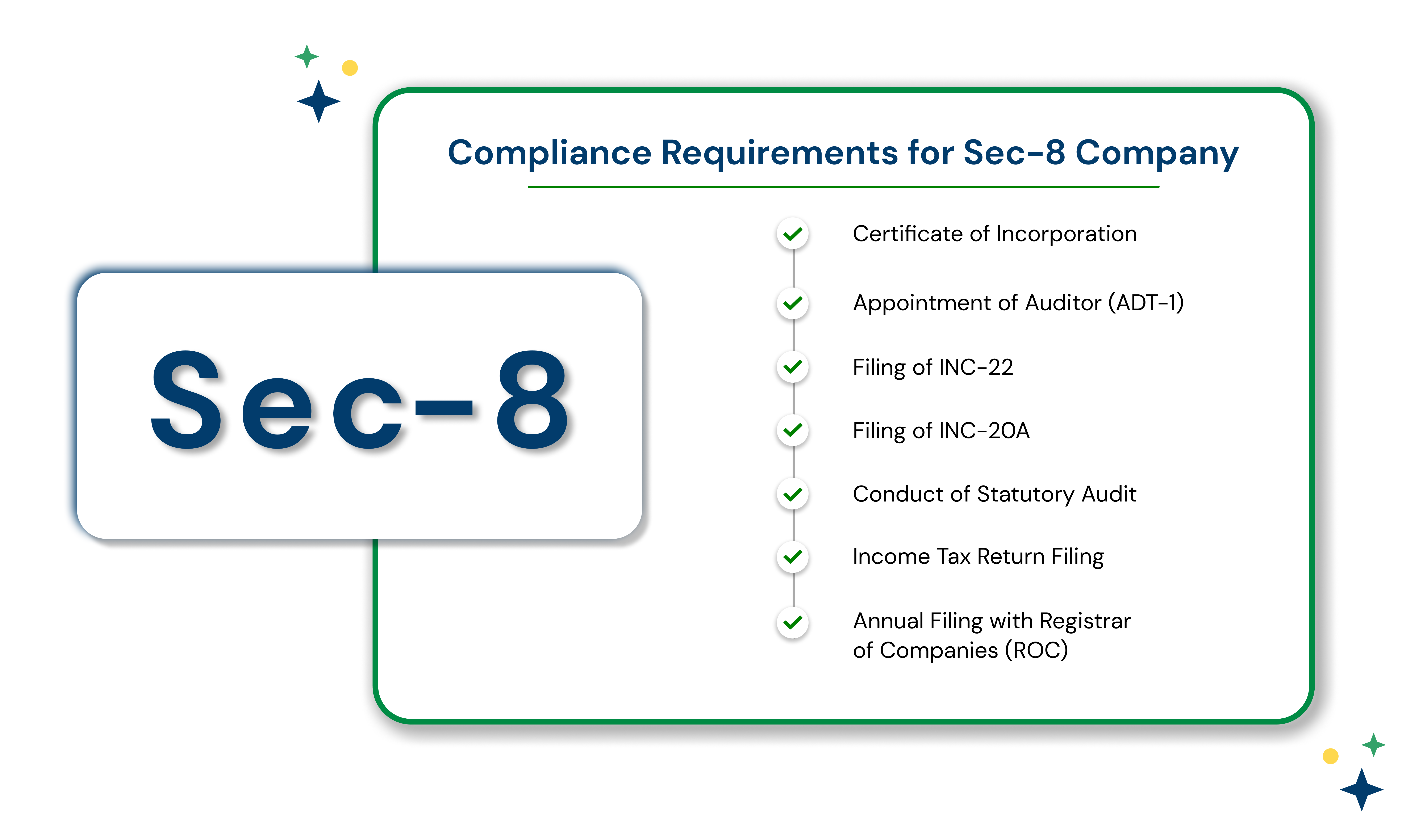
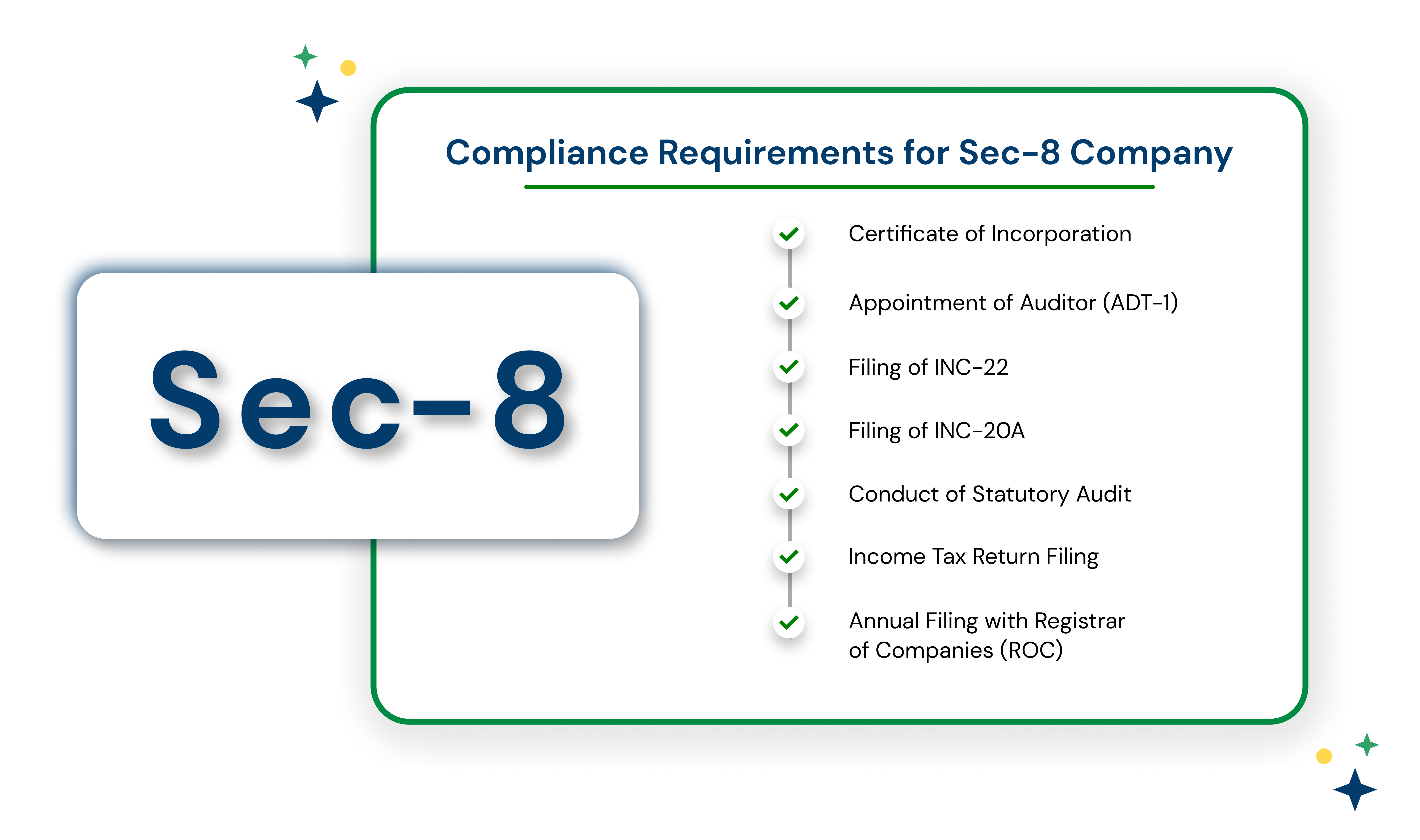
Section 8 companies enjoy certain benefits like tax exemptions and simplified registration processes. However, they must adhere to strict compliance requirements to maintain their non-profit status. These regulations ensure that the companies remain dedicated to their intended purposes and contribute positively to society.
A Section 8 company in India is a non-profit organization formed under the Companies Act, 2013. Its primary objective is to promote arts, science, commerce, research, education, charity, social welfare, religion, environmental protection, or any other similar purpose. These companies are prohibited from distributing profits to their members and must reinvest any earnings back into their activities.
Section 8 companies enjoy certain benefits like tax exemptions and simplified registration processes. However, they must adhere to strict compliance requirements to maintain their non-profit status. These regulations ensure that the companies remain dedicated to their intended purposes and contribute positively to society.
Types of Various Entites
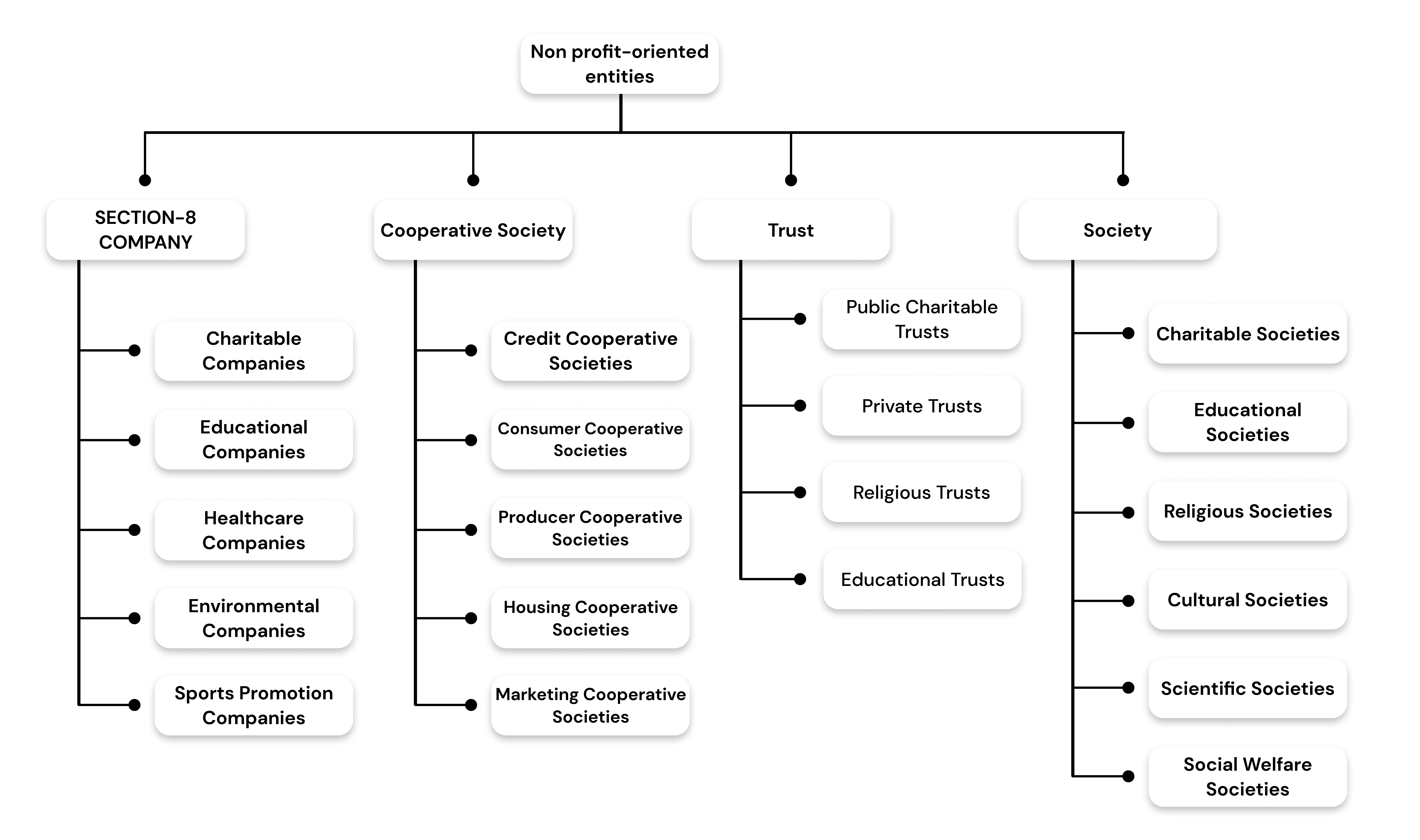
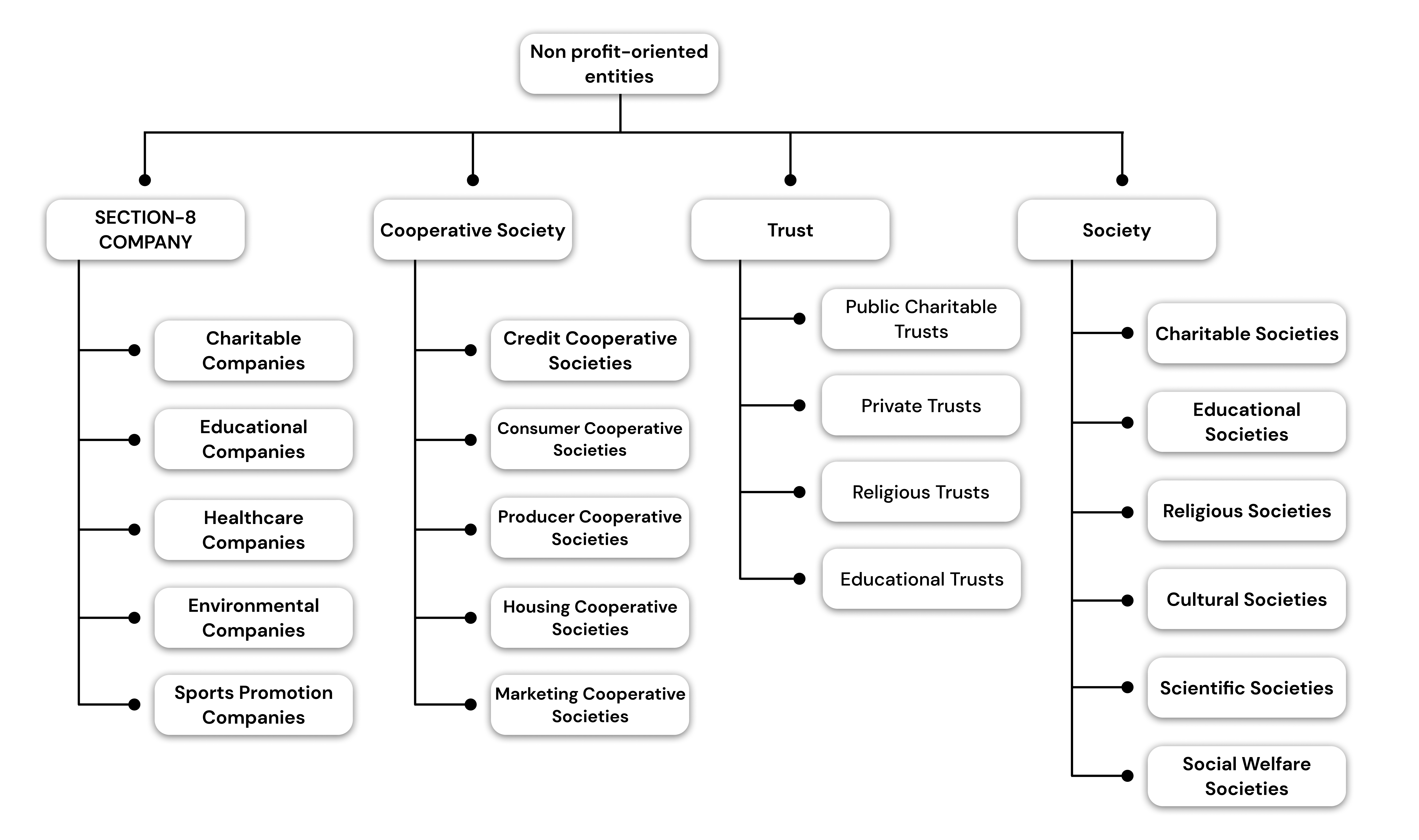
Helping entrepreneurs and business owners decide the most suitable legal structure for their operations.
| Feature | Section 8 Company | Cooperative Society | Trust | Society |
|---|---|---|---|---|
| Governing Act | Companies Act, 2013 | Cooperative Societies Act (varies by state) | Indian Trusts Act, 1882 (Private), Charitable and Religious Trusts Act, 1920 (Public) | Societies Registration Act, 1860 |
| Primary Objective | Promote charitable objectives such as commerce, art, science, sports, education, research, social welfare, religion, charity, and environmental protection | Mutual benefit and economic welfare of members | Charitable or religious purposes | Literary, scientific, charitable, and social welfare |
| Legal Status | Separate legal entity | Separate legal entity | No separate legal entity; trustee acts on behalf | Separate legal entity |
| Members/Trustees | Minimum of 2 (Private) or 3 (Public) directors | Minimum of 10 members | Minimum of 2 trustees | Minimum of 7 members |
| Control and Management | Board of Directors | Elected Managing Committee | Board of Trustees | Governing Body or Managing Committee |
| Liability | Limited liability | Limited liability | Trustees personally liable (unless specified otherwise) | Limited liability |
| Profit Distribution | Profits used to promote company’s objectives; no dividends | Profits distributed among members | No distribution; income used for trust purposes | No distribution; income used for society’s objectives |
| Compliance Requirements | High; annual filings, audit, board meetings | Moderate; annual returns, audit (varies by state) | Low; minimal annual compliance | Moderate; annual returns, audit (varies by state) |
| Tax Benefits | Eligible for tax exemptions under Section 12AA and 80G | Limited tax benefits | Eligible for tax exemptions under Section 12AA and 80G | Eligible for tax exemptions under Section 12AA and 80G |
| Dissolution | As per Companies Act, requires approval from NCLT | As per Cooperative Societies Act | As per Trust deed and court orders | As per Societies Registration Act |
| Examples of Activities | Running schools, hospitals, environmental projects | Providing credit, housing, consumer goods | Managing charitable activities, religious institutions | Running educational institutions, cultural programs |
Why opt for a Sec-8 Company?
Unlocking Your Business Potential with Private Limited Company Formation
Funding Opportunities
Easier access to grants and donations from government and international bodies.
Tax Benefits
Section-8 companies enjoy various tax exemptions and deductions under the Income Tax Act.
Social Impact
These companies are ideal for promoting social welfare, arts, charity, and education initiatives.
Perpetual Existence
These companies have continuous existence, unaffected by changes in membership.
No Minimum Capital
There is no mandatory minimum capital requirement to start a Section-8 company.
Enhanced Credibility
Registration as a Section-8 company boosts credibility and trust among donors and stakeholders.
Minimum Requirements
As Per Company Act 2013, there are Minimum Requirements That Need to be met For Sec-8 Company Incorporation in India.

Minimum 2 Directores

Unique bussiness Name

At least one director must be a resident of India

Registered office address
Required Documentation for Sec-8 Company Incorporation
To incorporate a Sec-8 Company in India, the following documents are required
Identity & Address of Directors
Registered Premises Documentation
Identity & Address of Directors
Scanned Copy of PAN & Aadhaar/Driving License/Passport/Voters ID
Copy of Recent Utility Bills (Not Older Than Two Months)
Scanned Copy of PAN & Aadhaar/Driving License/Passport/Voters ID
Copy of Recent Utility Bills or Bank Statement (Not Older Than 2 Months)
Digital Passport-Size Photo
Email ID & Phone Number
Copy of Recent Utility Bills or Bank Statement (Not Older Than 2 Months)
Scanned Notarized Rental Agreement (English Version)
Registered Premises Documentation
Copy of Recent Utility Bills (Not Older Than Two Months)
Scanned Notarized Rental Agreement (English Version)
Scanned No-Objection Certificate from Property Owner
Scanned Copy of Sale/Property Deed in English (For Owned Property)
Digital Passport-Size Photo
Scanned No-Objection Certificate from Property Owner
Email ID & Phone Number
Scanned Copy of Sale/Property Deed in English (For Owned Property)
Note: The registered office for your business can be a residential address; it does not need to be a commercial space.
Sec-8 Company Incorporation Procedure
Sec-8 Company Formation Made Easy
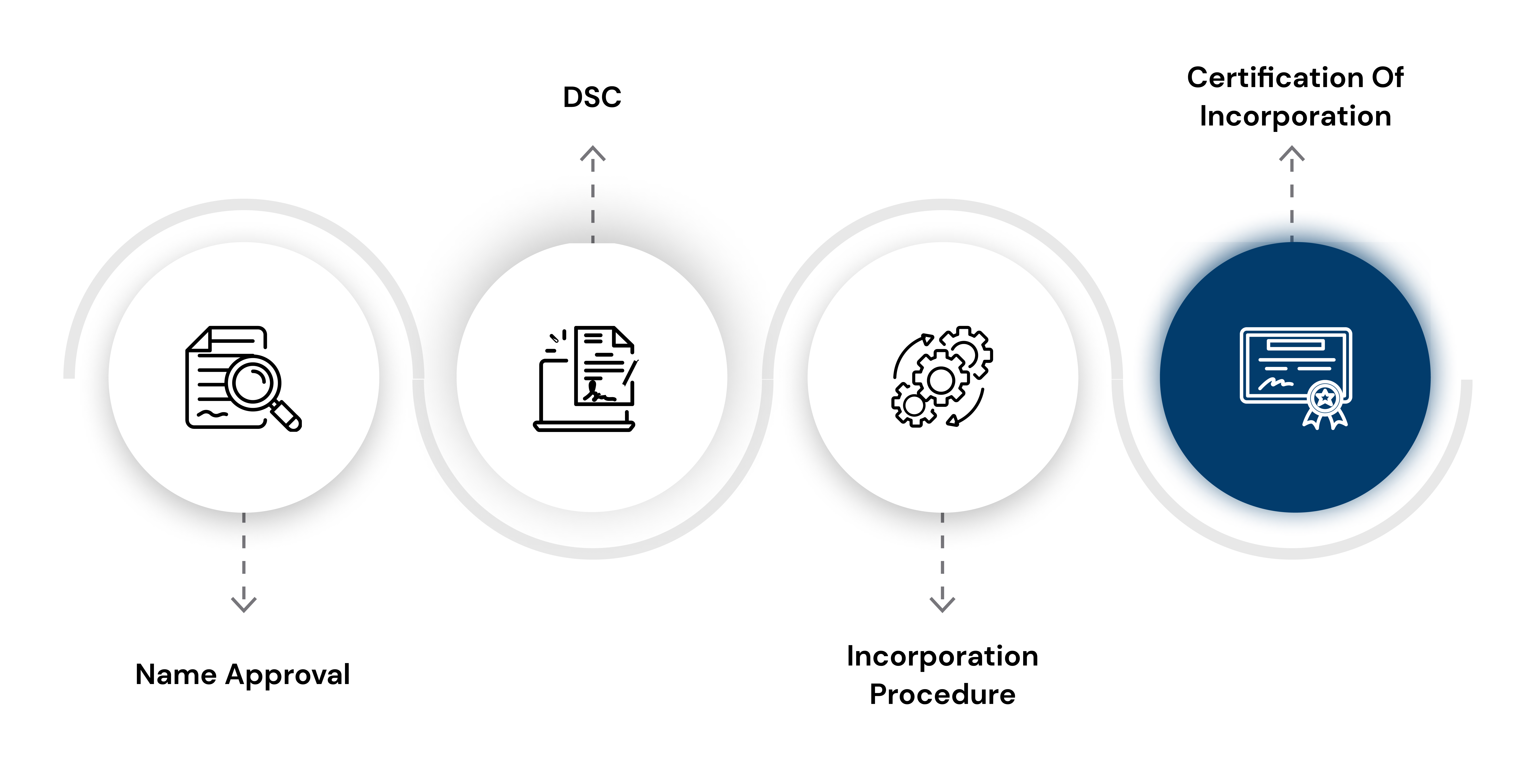

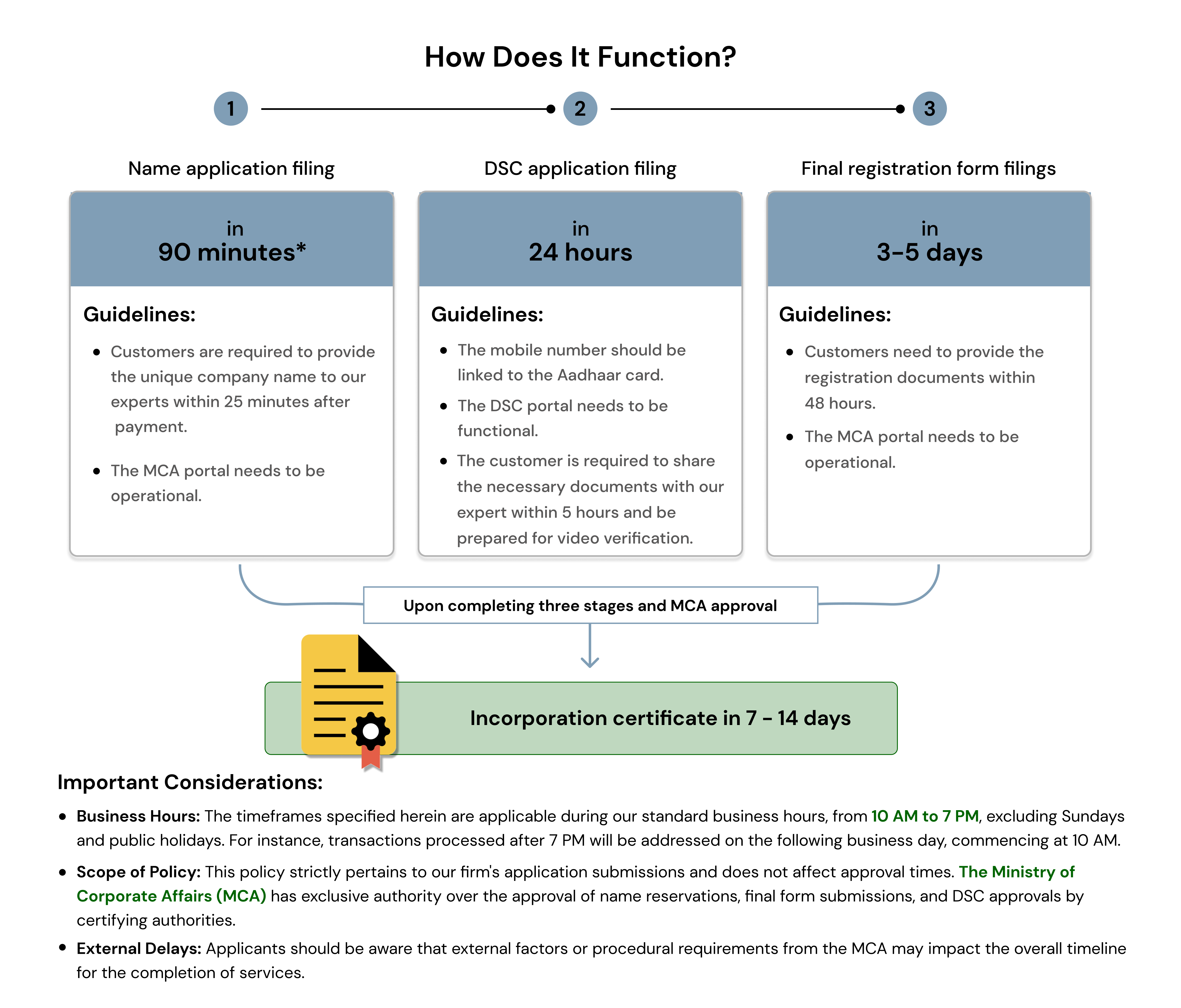
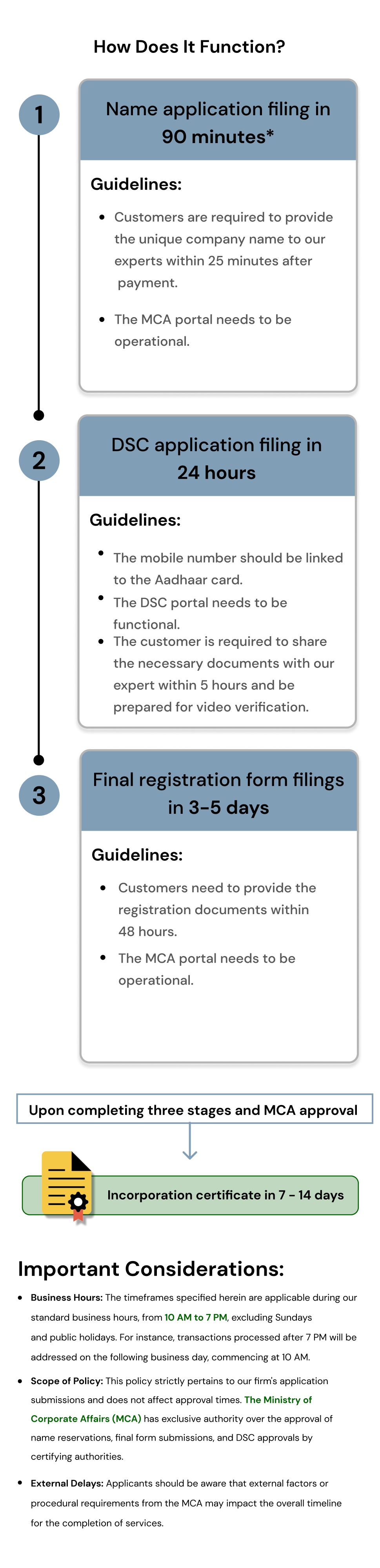
Reserving the Company Name is a critical step in the incorporation process
Process:
RUN Service (Reserve Unique Name): File an application in Form SPICe+ Part A for the reservation of the name.
Options: You can propose a maximum of two names at a time.
Guidelines: The name should be unique and not similar to any existing companies or trademarks.
Reservation Validity: The name reserved for the company is valid for a period of 20 days starting from the date it receives approval.
Description: The Second step is to obtain a Digital Signature Certificate (DSC) for the proposed Directors of the company. DSC is necessary for electronically signing the e-forms of company incorporation.
Process: DSC can be obtained from government-recognized certifying agencies. The applicant needs to provide a self-attested copy of their identity and address proof.
Validity: DSCs are typically valid for one to three years and can be renewed.
Following the successful reservation of the company name and acquisition of DSCs, the actual incorporation process begins. This procedure is detailed and requires careful attention to ensure compliance with all regulatory requirements.
Preparation or Drafting of Initial Documents
The foundation of a smooth incorporation process begins with the preparation of crucial documents:
DIR-2 (Consent to Act as Director): A formal declaration by individuals agreeing to serve as directors, outlining their consent and commitment to undertake the roles and responsibilities.
Specimen Signature Card: Used for the Registrar of Companies (RoC) to verify the signatures of the company’s proposed signatories.
Drafting Memorandum of Association (MoA) and Articles of Association (AoA)
The initial documents set the stage for drafting the two most crucial documents for a Section 8 Company:
Memorandum of Association (MoA): Outlines the scope of operations, objectives, and the framework within which the company operates. It specifically includes the nonprofit objectives of the company, aiming to benefit society.
Articles of Association (AoA): Establishes the rules governing the internal management of the company. It details the conduct of its business and the rights and responsibilities of its members, aligned with the nonprofit nature of the organization.
Filling Out SPICe+ Part B
Under the new guidelines, the need to file Form INC-12 for obtaining a license has been eliminated. Instead, the application for a Section 8 Company license is integrated into the SPICe+ form, streamlining the process:
SPICe+ Form: This single, integrated form is used for the reservation of the name, incorporation, DIN application, and other necessary compliance registrations (like PAN, TAN). For a Section 8 Company, this form will also include sections pertaining to the application for a Section 8 License.
The form requires detailed information including:
- Company name
- Registered office address
- Capital structure
- Director and subscriber details
Additionally, for Section 8 Companies, it requires the submission of:
- A brief about the company’s proposed charitable or not-for-profit objectives
- Projected income and expenditure for the next three years to demonstrate the non-profit motive and ensure financial viability.
Filling out this form accurately is critical as it establishes the company’s legal identity and ensures compliance with the requirements for nonprofit entities.
Completing AGILE-PRO Form
Parallel to the SPICe+ Part B submission, the incorporation process also involves completing the AGILE-PRO form. This form ensures that the company is registered for:
- Goods and Services Tax Identification Number (GSTIN)
- Employees’ State Insurance Corporation (ESIC)
- Employees’ Provident Fund Organisation (EPFO)
- Professional Tax (PT)
- Opening of a bank account
This step ensures that the company complies with various statutory requirements from the outset.
INC-9 Auto-Generation
The final step in the documentation process before submission is:
INC-9: Automatically generated based on the details provided in SPICe+ Part B, this form is a declaration by the subscribers and first directors, confirming their consent and details as submitted in the incorporation application.
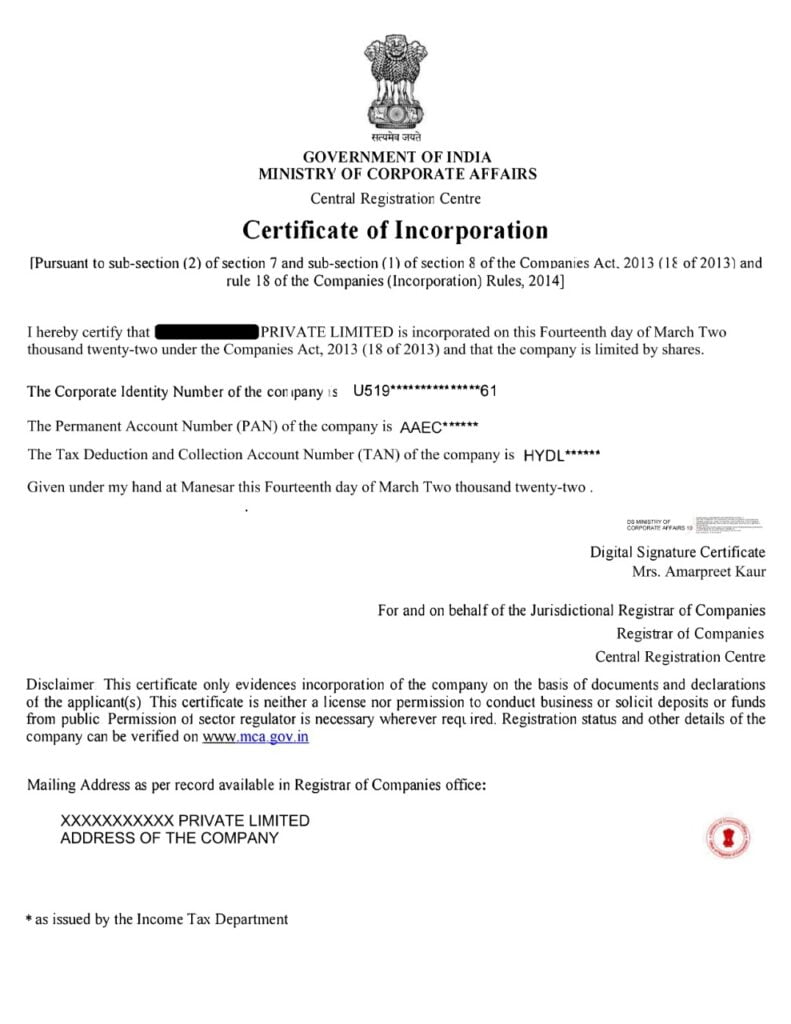
Upon the successful submission of the forms and verification by the RoC, the company is issued a Certificate of Incorporation.
Certificate of Incorporation:
This is a crucial document, serving as proof that the company has been legally constituted and includes the Company Identification Number (CIN) along with the PAN and TAN issued to the company.
Documents Received After Company Formation
Incorporation Certificate 
Permanent Account Number (PAN) of the company
Tax Deduction Account Number (TAN) of the Company
Articles Of Association (AOA)
Memorandum Of Association (MOA)
Direction Identification Number (DIN)
Digital Signature Certificate (DSC)
Company Master Data
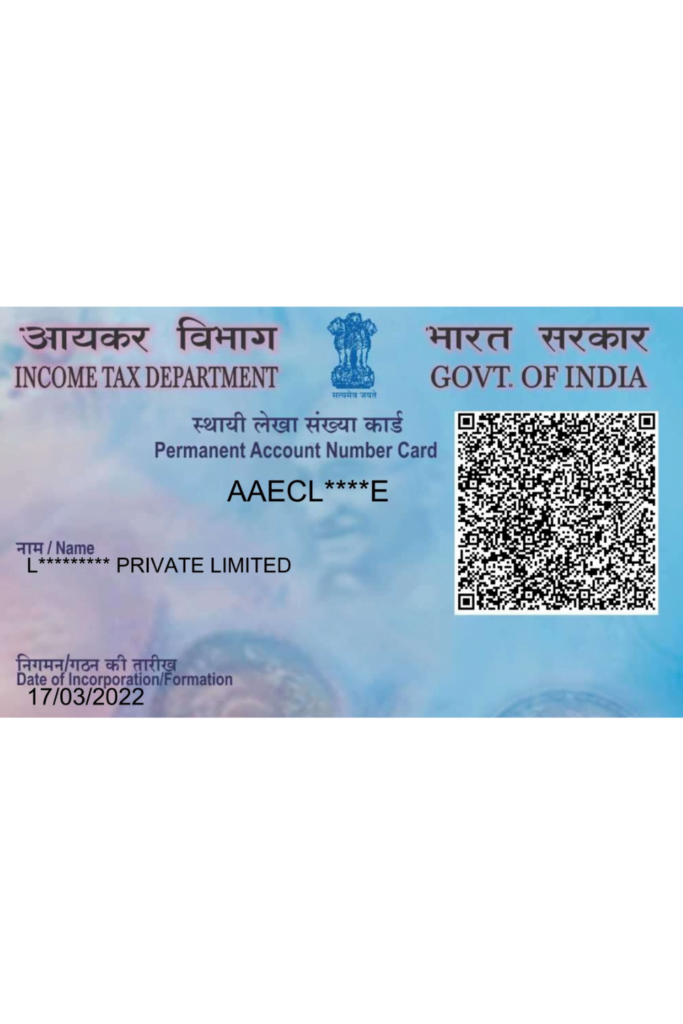
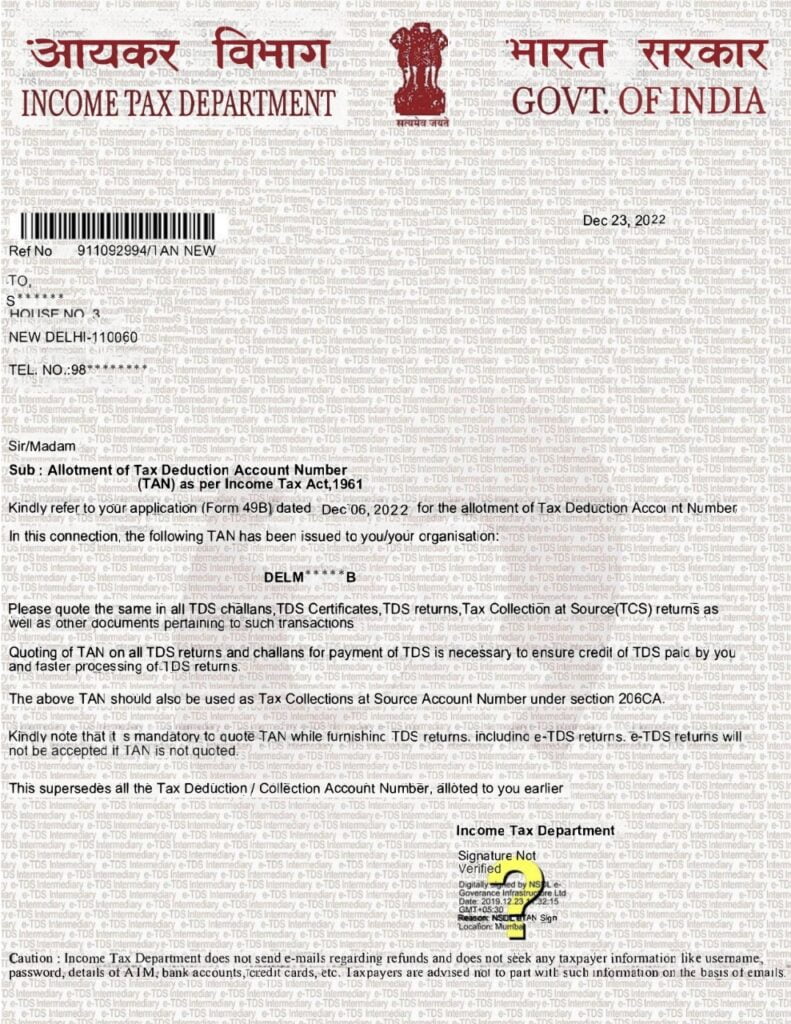
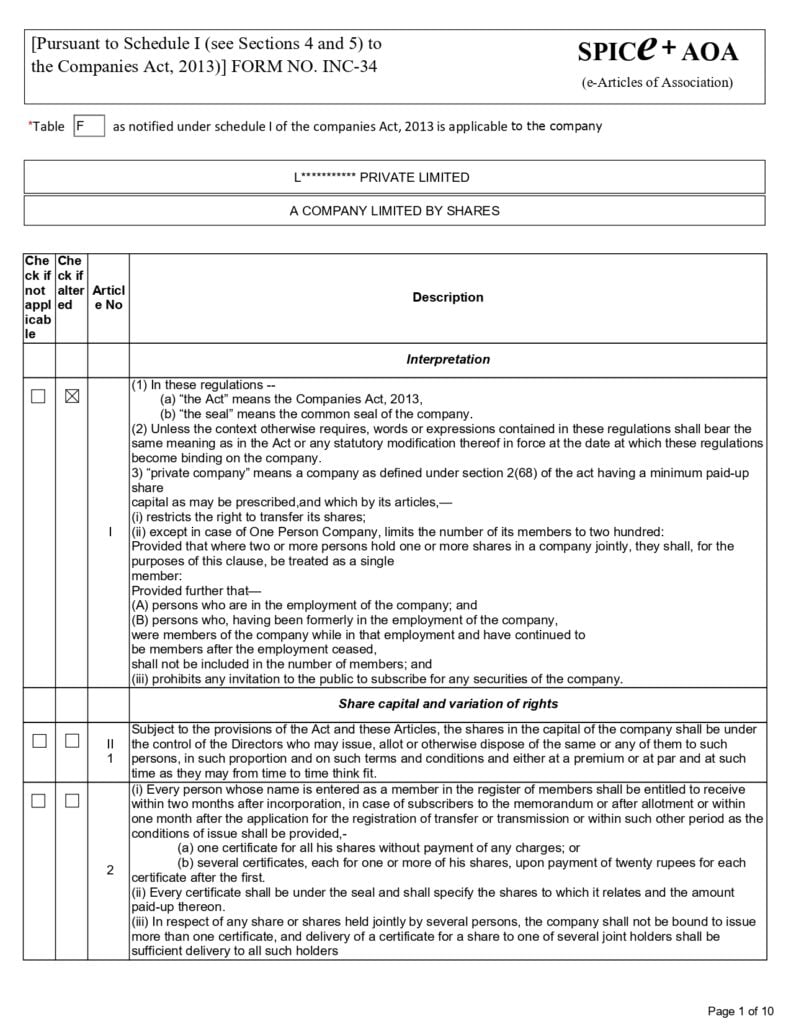
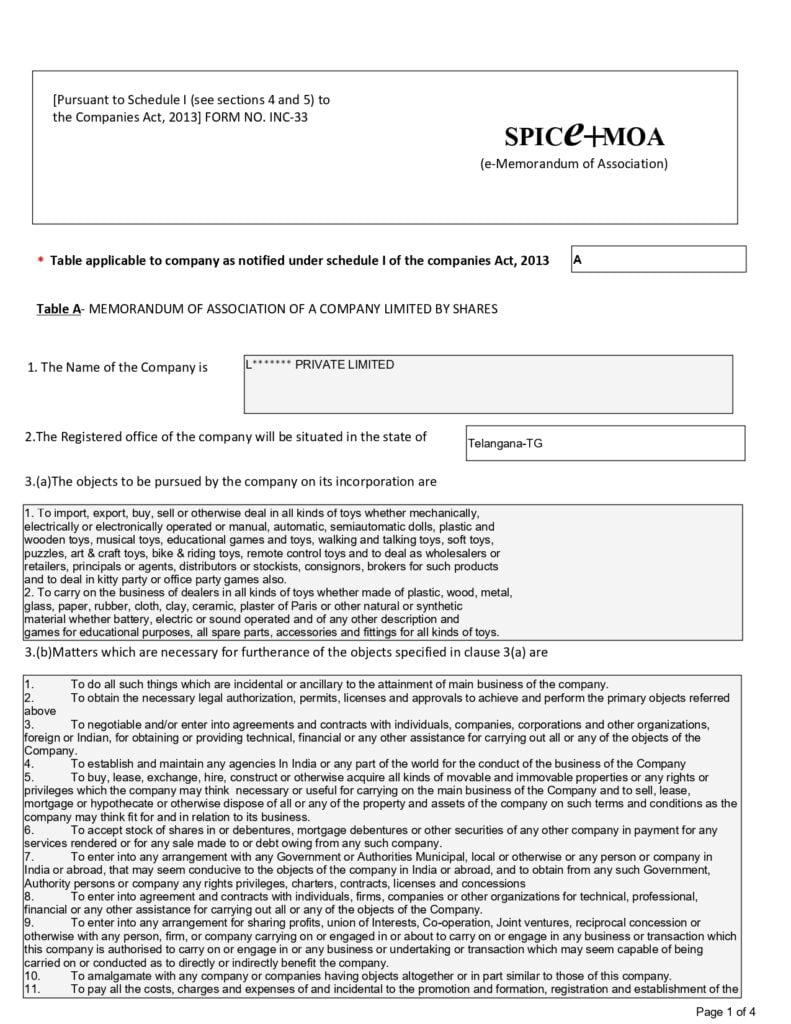


Post Incorporation Compliances
Compliances for a Private Limited Company in India as required by the Ministry of Corporate Affairs (MCA), the Companies Act 2013, and other applicable laws
- Opening of a bank account
- First board meeting of the company
- Appointment of first auditors (ADT-1)
- Disclosure of director’s interests (MBP-1)
- Filing of INC-22
- Printing of letterhead & statutory registers
- Deposit of subscription money as per MOA
- Allotment of shares (PAS-3)
- Issuance of share certificates
- Payment of stamp duty
Filing of INC-20A to ROC (Declaration for Commencement of Business)
- Maintenance of statutory registers
- Register of members
- Register of charges
- Register of KMP
- Register of loans & advances etc
- Minutes for Board & General Meetings
- Managing books of accounts
- Convening & holding the AGM
- Adoption of Annual Financial Statements
- Filing of AOC-4, MGT-7 to the ROC
- Filing of Income Tax Return (ITR)
- Filing DIR-3 KYC of Directors to ROC
- CSR Compliance
- Changes in Directorship or Shareholding
- Change in Registered Office (INC-22)
- Alterations in MOA or AOA
- Loans, Investments, & Guarantees (MGT-14)
- Creation or Modification of Charges (CHG-1)
Darpan, 12AA & 80G Registrations
For Section-8 Companies
1
NGO Darpan Registration
NGO Darpan registration, managed by NITI Aayog, is essential for Section 8 companies to enhance transparency and legitimacy. It facilitates easier access to government grants and schemes, and is often required by banks for opening current accounts.
2
12AA Registration & 80G Registration
Registration under Section 12AA provides tax exemption for non-profits on their surplus income, crucial for operational efficiency. Section 80G enables donors to receive tax deductions on donations, enhancing the attractiveness for potential donors and aiding the organization’s fundraising efforts.
Frequently Asked Questions
What is a Section 8 Company under the Companies Act, 2013?
A Section 8 Company is a type of nonprofit organization established for promoting charitable or social objectives. It operates under the Companies Act, 2013.
Can a Section 8 Company distribute profits to its members?
No, a Section 8 Company cannot distribute profits or dividends to its members. All income must be used for the company's charitable purposes.
What are the objectives for which a Section 8 Company can be formed?
A Section 8 Company can be formed for the promotion of art, science, sports, education, research, social welfare, religion, charity, protection of the environment, or any other charitable purpose.
Can a Section 8 Company be converted into a for-profit company later?
No, a Section 8 Company cannot be converted into a for-profit company.
Is there a minimum capital requirement for registering a Section 8 Company?
There is no specific minimum capital requirement for registering a Section 8 Company.
How is the registration process different for a Section 8 Company compared to a regular company?
The registration process for a Section 8 Company is similar to that of a regular company, with additional requirements related to the charitable objects and restrictions on profit distribution.
What is the process for obtaining tax benefits for a Section 8 Company under the Income Tax Act?
To avail tax benefits, a Section 8 Company must apply for tax-exempt status under Section 12A of the Income Tax Act, and donations to the company should be eligible for deductions under Section 80G.
Can a Section 8 Company own property and assets?
Yes, a Section 8 Company can own property and assets in its name, which should be used for achieving its charitable objectives.
Are there any compliance requirements for a Section 8 Company under the Companies Act?
Yes, Section 8 Companies are required to adhere to various compliance and reporting requirements, including annual financial statements and returns as per the Companies Act.
Can foreign contributions be received by a Section 8 Company for charitable purposes?
Yes, a Section 8 Company can receive foreign contributions, but it must obtain prior permission or registration under the Foreign Contribution (Regulation) Act, 2010.
What is the procedure for altering the objectives of a Section 8 Company?
To alter the objectives, a Section 8 Company must seek approval from the Registrar of Companies and follow the prescribed procedures under the Companies Act.
Can a Section 8 Company be dissolved or wound up?
Yes, a Section 8 Company can be dissolved voluntarily by following the provisions specified in the Companies Act, or it can be wound up by the court if it fails to comply with statutory requirements.
How can I become a member of a Section 8 Company?
Membership in a Section 8 Company is typically by invitation, and individuals or organizations interested in the company's objectives can apply for membership following the company's rules and regulations.
Can a Section 8 Company undertake commercial activities to support its charitable objectives?
Yes, a Section 8 Company can engage in commercial activities, but the profits generated must be used exclusively for promoting its charitable purposes.
What are the penalties for non-compliance with the provisions of the Companies Act by a Section 8 Company?
Non-compliance can result in penalties, fines, or even dissolution of the Section 8 Company. It's important to adhere to the legal requirements to maintain the company's status.