
Voluntary Winding up of Company| Companies Act, 2013 & Insolvency and Bankruptcy Code, 2016
Winding up, or liquidation, involves selling a company’s assets to settle its debts. Shareholders receive any remaining funds after debts and expenses are paid, leading to the company’s dissolution.
- No Hidden Charges
- Lowest Price Guarantee
No Hidden Charges
Lowest Price Guarantee
Posted onTrustindex verifies that the original source of the review is Google. Audit Tick streamlined our company registration seamlessly. Their team was efficient, knowledgeable, and extremely helpful throughout the process. Highly recommended for quick and reliable service!Posted onTrustindex verifies that the original source of the review is Google. Knowledgeable staff I never metPosted onTrustindex verifies that the original source of the review is Google. awesome audit work with audit tickPosted onTrustindex verifies that the original source of the review is Google. Good workPosted onTrustindex verifies that the original source of the review is Google. Working skills awesomePosted onTrustindex verifies that the original source of the review is Google. Work is goodPosted onTrustindex verifies that the original source of the review is Google. Nice experience with audit tick for It returns fillingPosted onTrustindex verifies that the original source of the review is Google. SuperrrrbPosted onTrustindex verifies that the original source of the review is Google. Excellent audit filling with audit tickPosted onTrustindex verifies that the original source of the review is Google. Iam fully satisfied with Audit tick, superrrrb
- Home
- Compliance & Accounting
- Winding Up Of Company
Four Steps to Obtain Your Certificates/Licenses
Fill the Form
Provide business details
Add to cart
Pay the required fee online
Submit Documents
Upload required papers
Certificate delivery
Official Document Delivery
Find the best plan for your needs
What is Winding Up
Winding up is the formal legal process of closing a company’s operations, settling all obligations, and removing the company’s name from the official records of the Ministry of Corporate Affairs (MCA).
Once a company is wound up:
- It ceases to exist as a legal entity
- No further compliance or liabilities arise
- Directors and shareholders are discharged of responsibility
Whether your business is inactive, insolvent, or simply no longer needed — winding up gives you a clean and lawful exit.
Is Winding Up the Same as Liquidation?
Need to Update
Not exactly.
Winding up is the overall process of closing a company, while liquidation is a part of that process where assets are sold, and dues are cleared.
Winding Up = Full legal closure
Liquidation = Selling assets + settling dues
All liquidations are part of winding up, but not all winding-up processes involve formal liquidation (e.g., in debt-free strike-off cases).
Key Differences at a Glance
Need to Upload
| Particulars | Strike-Off | Voluntary Winding Up | Compulsory Winding Up |
|---|---|---|---|
| Applicable Law | Sec 248 of Companies Act | Sec 304/IBC Sec 59 | Sec 271 of Companies Act |
| Company Type | Inactive, debt-free | Active, solvent | Insolvent or fraudulent |
| Initiated By | Company itself | Company members | NCLT, creditors, ROC |
| Liquidator Appointed | No | Yes | Yes |
| Duration | 3–6 months | 6–12 months | 12–18+ months |
Need to update
Need to update
Risks of Not Winding Up Properly
Failing to close your company legally can result in:
- Late fees & penalties from ROC
- Disqualification of directors (Section 164)
- Legal action by creditors, employees, or tax authorities
- Impact on future business registrations
- Ongoing compliance burden (filings, audits, taxes)
Post-Winding Up Compliance Checklist
After winding up, make sure to:
- Close bank accounts
- Surrender GST, PAN, TAN, ESI, PF registrations
- Inform vendors and clients
- Secure all MCA acknowledgment letters
- Keep a copy of the dissolution certificate for records
Procedure for Winding Up of a Company
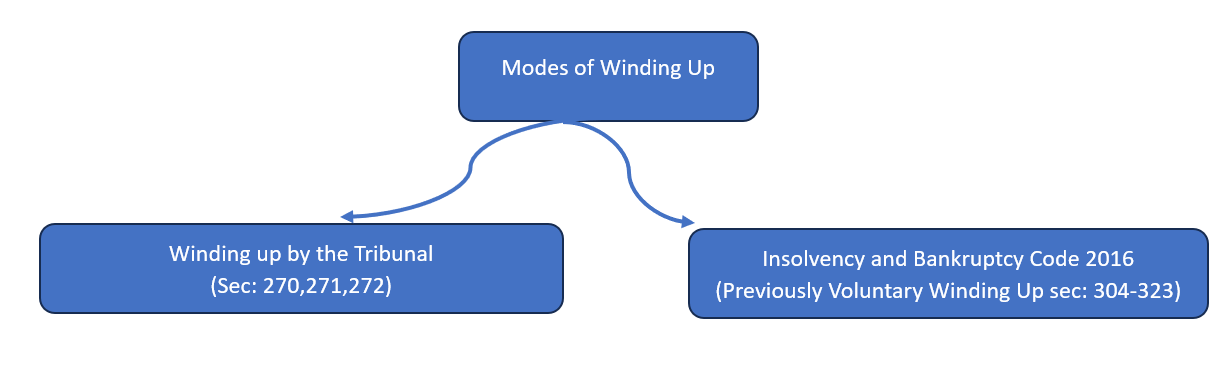
The winding-up process of a company can be executed under different modes, primarily categorized into:
Initiation:
Petition Submission: The process begins with the submission of a petition to the Tribunal. Petitioners can include the company itself, creditors, shareholders (contributories), the Registrar, or any person authorized by the Central Government.
Grounds for Winding Up: The Tribunal can order winding up on various grounds, including the company’s inability to pay debts, the company acting against the sovereignty and integrity of India, and just and equitable reasons.
Procedure:
Appointment of Liquidator: Upon accepting the winding-up petition, the Tribunal appoints a liquidator to oversee the process.
Public Announcement: A public announcement is made to inform the creditors and stakeholders of the winding up.
Collection and Realization of Assets: The liquidator takes control of the company’s assets, realizes them (turns them into cash), and assesses the company’s liabilities.
Payment of Debts: Debts are paid in an order of priority, ensuring secured creditors, unsecured creditors, and statutory dues are settled.
Distribution of Surplus: Any surplus after debt payment is distributed among the shareholders according to their rights.
Dissolution Order: The liquidator submits a final report to the Tribunal. If satisfied, the Tribunal issues an order for the company’s dissolution.
Final Steps:
Striking off the Register: The company’s name is struck off from the Registrar of Companies, and the dissolution is published in the Official Gazette.
Initiation:
Insolvency Resolution Process (IRP): This process starts with the filing of an insolvency petition by either financial or operational creditors, or the company itself through voluntary insolvency.
Moratorium and Public Announcement: Upon admitting the petition, a moratorium period commences, and a public announcement is made to invite claims from creditors.
Procedure:
Appointment of Resolution Professional: An insolvency professional is appointed to manage the company’s affairs and form a committee of creditors (CoC).
Preparation and Approval of Resolution Plan: The CoC prepares a resolution plan which may involve restructuring the company’s debts or preparing it for sale.
Implementation of the Plan: If the CoC approves the resolution plan, it is implemented under the supervision of the resolution professional.
Liquidation: If the resolution plan fails or is not approved within the stipulated timeframe, the company is put into liquidation.
Liquidation Process under IBC:
Liquidation Order: The adjudicating authority orders the liquidation of the company.
Appointment of Liquidator: The resolution professional may act as the liquidator, taking over the company’s assets to liquidate them.
Distribution of Proceeds: The proceeds from the sale of assets are distributed in accordance with the priority set out in the Code.
Dissolution: Once the assets have been liquidated and debts paid, the company is dissolved.
Final Steps:
The liquidator submits a final report to the adjudicating authority, which then passes an order for dissolution. The company’s name is subsequently removed from the Registrar of Companies.
Each mode of winding up has specific procedures and outcomes, designed to ensure that the interests of creditors, shareholders, and other stakeholders are addressed equitably. The choice of the winding-up mode depends on various factors, including the reasons for winding up, the company’s financial health, and stakeholders’ preferences.
Frequently Asked Questions
Can I apply for winding up without clearing all liabilities?
No, you must settle all dues before voluntary strike-off or obtain NCLT approval for compulsory winding up.
How long does the winding-up process take?
- Strike-off: 3–6 months
- Voluntary winding up: 6–12 months
- Compulsory winding up: 12–18+ months
Is ROC approval enough to close a company?
Yes, for strike-off and voluntary cases. In compulsory cases, NCLT also passes the dissolution order.
What if ROC has already issued notices for non-compliance?
You may still apply for winding up, but first respond to notices and bring filings up to date.
Can I restart the company after winding up?
No. Once dissolved, the company is permanently removed and cannot operate again.