Increase Authorised Share Capital (Companies Act, 2013)
Increasing a company’s capital base is a conditional compliance measure. It necessitates officially raising the authorized capital by submitting the necessary documentation to the Registrar of Companies whenever a company opts to enhance its capital.
- No Hidden Charges
- Lowest Price Guarantee
No Hidden Charges
Lowest Price Guarantee
Posted onTrustindex verifies that the original source of the review is Google. Audit Tick streamlined our company registration seamlessly. Their team was efficient, knowledgeable, and extremely helpful throughout the process. Highly recommended for quick and reliable service!Posted onTrustindex verifies that the original source of the review is Google. Knowledgeable staff I never metPosted onTrustindex verifies that the original source of the review is Google. awesome audit work with audit tickPosted onTrustindex verifies that the original source of the review is Google. Good workPosted onTrustindex verifies that the original source of the review is Google. Working skills awesomePosted onTrustindex verifies that the original source of the review is Google. Work is goodPosted onTrustindex verifies that the original source of the review is Google. Nice experience with audit tick for It returns fillingPosted onTrustindex verifies that the original source of the review is Google. SuperrrrbPosted onTrustindex verifies that the original source of the review is Google. Excellent audit filling with audit tickPosted onTrustindex verifies that the original source of the review is Google. Iam fully satisfied with Audit tick, superrrrb
- Home
- Compliance & Accounting
- Increase Authorized Share
Four Steps to Obtain Your Certificates/Licenses
Fill the Form
Provide business details
Add to cart
Pay the required fee online
Submit Documents
Upload required papers
Certificate delivery
Official Document Delivery
Overview of Increase Authorized Share Capital
Increasing the authorized share capital of a company in India is governed by the Companies Act, 2013, and its associated rules. The process begins with a board meeting to approve the proposal, followed by an extraordinary general meeting (EGM) where shareholders pass a special resolution. The company must then file Form SH-7 with the Registrar of Companies (RoC) within 30 days, along with the requisite fee and supporting documents, including a copy of the resolution and altered Memorandum of Association (MoA).
Upon submission, the RoC reviews the application, and if all documents are in order, updates the company’s authorized share capital in the records. This increase allows the company to issue additional shares, enabling it to raise more capital for expansion, operations, or other financial needs. Compliance with these procedures ensures legal validity and transparency in the capital structure of the company.

Overview
Authorized Share Capital is the maximum capital a company can issue to shareholders as per its Memorandum of Association (MOA). It sets the legal ceiling on the amount of share capital a company can raise and represents the potential financial strength of the business.
If a company plans to raise more funds, issue additional shares, or expand operations, it must increase its authorized share capital through a legal process that includes shareholder approval and regulatory compliance under the Companies Act, 2013.
This guide explains what authorized capital is, why it’s important, how to increase it, and the legal procedures involved.
Types of Share Capital in a Company
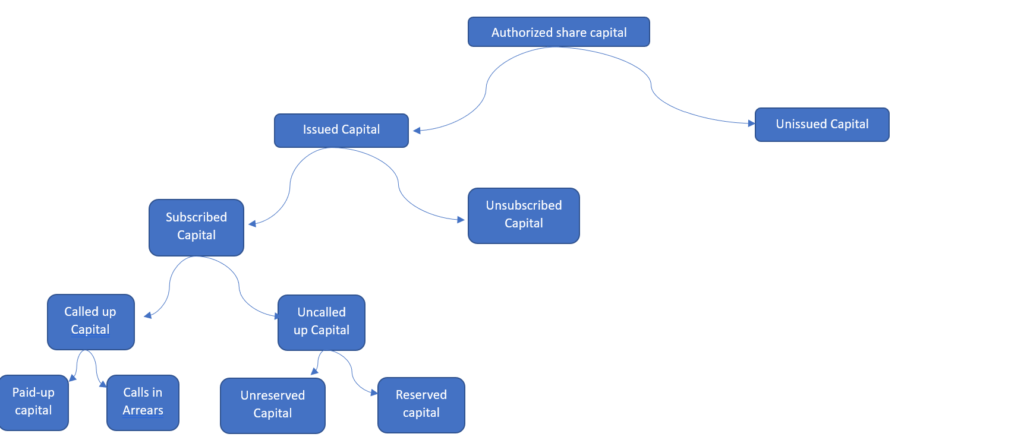
Share capital plays a vital role in the financial structure of a company. Here’s a breakdown of the different types
| Type of Share Capital | Definition |
|---|---|
| Authorized Share Capital | The maximum capital a company is allowed to issue as per its MOA. |
| Issued Share Capital | The portion of authorized capital that the company has actually allocated to shareholders. |
| Subscribed Capital | The amount of issued capital that investors have agreed to buy. |
| Called-Up Capital | The amount that shareholders are required to pay on issued shares. |
| Paid-Up Capital | The actual amount received from shareholders for shares allotted. It cannot exceed authorized capital. |
Example: If a company has an authorized capital of ₹10 crores but has only issued ₹5 crores worth of shares, then ₹5 crores remain unissued and can be used in the future without increasing the authorized capital.
Why Increase Authorized Share Capital
A company may increase its authorized capital for several reasons
To Raise More Funds
Issue new shares and bring in more investment.
For Business Expansion
Invest in growth, R&D, or entering new markets.
For Mergers & Acquisitions
Issue shares to merge with or acquire other companies.
To Offer Employee Stock Options (ESOPs)
Reward employees with company shares.
To Attract New Investors
Allow more shareholders to invest in the company.
To Comply with Regulations
Some industries have a minimum capital requirement.
Example: A company with an authorized capital of ₹2 crores wants to raise ₹5 crores from new investors. It must first increase its authorized capital before issuing more shares.
Difference Between Authorized Capital & Paid-Up Capital
Need to Update
| Feature | Authorized Share Capital | Paid-Up Share Capital |
|---|---|---|
| Definition | Maximum capital the company can issue as per its MOA. | The actual amount paid by shareholders for issued shares. |
| Purpose | Sets a legal limit for future fund-raising and share issuance. | Reflects the real investment received from shareholders. |
| Changeability | Can be increased by altering the MOA with shareholder approval. | Can only increase within the authorized limit by issuing more shares. |
| Impact on Business | Determines future growth potential. | Reflects the company's current financial strength. |
Key Takeaway: Paid-up capital can NEVER exceed authorized capital. If a company wants to issue more shares beyond its limit, it must increase its authorized share capital first.
What is Authorized Share Capital
Authorized share capital represents the maximum value of shares a company can issue to shareholders. It is stated in the MOA and serves as an upper limit for raising funds.
Key Points to Know:
✅ It is NOT the actual money raised – It’s just the maximum limit allowed.
✅ Can be increased or decreased – With proper approvals.
✅ Company CANNOT issue shares beyond this limit – Unless it legally increases its authorized capital.
✅ Reflected in the MOA (Memorandum of Association) – Under the capital clause.
Example: A public company expanding to new markets may increase board size for better governance.
Process for for Increasing Authorized Share Capital
Follow these simple steps to apply for Increasing Authorized Share Capital

- Review the AOA to see if it permits an increase in authorized capital.
- If NOT, the AOA must be amended first through a special resolution.
✅ Issue Notice – Send notice to all directors at least 7 days before the meeting.
✅ Pass a Board Resolution – Approve the capital increase and call for an Extraordinary General Meeting (EGM).
✅ Appoint an officer to handle the filings with the Registrar of Companies (ROC).
Required Document: Certified Board Resolution Copy
✅ Issue Notice – Inform shareholders at least 21 days before the EGM.
✅ Pass a Special Resolution – Get shareholder approval to amend the MOA (Capital Clause).
Required Document: Certified Special Resolution Copy
✅ Form MGT-14 (If AOA is Amended)
- File within 30 days of the resolution.
- Attach:
- Board Resolution Copy
- Special Resolution Copy
- Updated AOA (if applicable)
✅ Form MGT-14 (If AOA is Amended)
- File within 30 days of the resolution.
- Attach:
- Board Resolution Copy
- Special Resolution Copy
- Updated AOA (if applicable)
Key Takeaway: Late filing leads to penalties and delays.
Need to Need
Need to Update
Need to Update
Government Fees for Increasing Authorized Share Capital
The ROC charges a government fee based on the amount of capital increase.
Tip: Additional stamp duty may apply based on state regulations.
Why Increase Authorized Share Capital?
Increasing the authorized share capital of a company can have several strategic and financial implications. Here's a brief overview
Enables Further Capital Raising
Supports Business Expansion
Enhances Credibility
Facilitates Strategic Alliances
Attracts and Retains Talent
Flexibility in Financial Management

Enables Further Capital Raising
Increasing authorized share capital allows a company to issue more shares, raising additional funds.

Supports Business Expansion
With more capital, a company can finance expansion projects, R&D, and enter new markets.

Enhances Credibility
A higher authorized share capital can improve a company's image, making it more attractive to investors.
Facilitates Strategic Alliances
More shares can be used as a tool for mergers, acquisitions, or forming strategic partnerships.

Attracts and Retains Talent
Additional shares can be allocated for employee stock option plans, helping to attract and retain top talent.

Flexibility in Financial Management
It provides flexibility in financial decisions, such as stock splits and dividend policies.
Differences between authorized & paid-up share capital
Here’s a table outlining four important differences between authorized share capital and paid-up share capital:
| Feature | Authorized Share Capital | Paid-Up Share Capital |
|---|---|---|
|
Definition |
The maximum amount of share capital that a company is authorized to issue to shareholders as per its Articles of Association. |
The part of the authorized share capital that has been issued and fully paid by shareholders. |
|
Purpose |
Represents the growth potential and the ceiling up to which a company can raise capital through the issuance of shares. |
Indicates the actual capital that has been invested by shareholders and is available to the company for use. |
|
Change |
Can be increased or altered by following a specific legal procedure, including passing a resolution in a general meeting and filing with regulatory authorities. |
Can be increased by issuing more shares up to the limit of authorized share capital but cannot exceed the authorized limit without amending it. |
|
Impact on Company Value |
Reflects the potential for future expansion and does not directly affect the company’s current financial position. |
Represents the actual capital contributed by shareholders and directly impacts the company’s equity and financial stability. |
Share capital can be classified as follows
Procedure For Increasing Authorized Share Capital
Increasing the authorized share capital of a company in India involves a series of regulatory steps as per the Companies Act, 2013. Here’s a detailed guide with a clear presentation of the procedure:
Initial Check: Verify the Articles of Association (AoA) to ensure that the company has the provision to increase its authorized share capital. If not, the AoA must be altered first.
Convening the Meeting: Issue notices to all directors to convene a Board meeting.
Agenda Items: Discuss and approve the increase in authorized share capital, alteration of the AoA (if necessary), and fix the date, time, and agenda for the Extraordinary General Meeting (EGM) to obtain shareholders’ approval.
Notice of EGM: Issue a notice for the EGM to all shareholders, directors, and auditors of the company, clearly stating the agenda.
Passing of Resolution: At the EGM, pass an ordinary resolution for the increase of authorized share capital and, if required, an ordinary or special resolution for the alteration of the AoA.
Form SH-7: Within 30 days of passing the resolution, file Form SH-7 with the Registrar of Companies (RoC) through the MCA (Ministry of Corporate Affairs) portal.
Attachments: Attach the following documents to Form SH-7:
• Altered MoA and AoA, if applicable.
• Minutes of the EGM showing the passing of the resolution.
• A copy of the board resolution authorizing the capital increase.
Verification: The RoC will examine the filed documents and, upon satisfaction, approve the increase in authorized share capital.
Certificate of Registration: Upon approval, the RoC issues a certificate of registration regarding the alteration of the capital clause in the MoA.
Post-Increase Authorized Share Capital Compliances
NEED TO ADD TEXT HERE
Updating Company Records
Statutory Registers: Update all relevant statutory registers, including the Register of Members and the Register of Share Allotments, to reflect the new authorized share capital.
Articles of Association (AoA): If the AoA was amended to increase the authorized share capital, ensure the updated AoA is recorded and accessible.
Compliance with SEBI Regulations
For listed companies in India, it is crucial to comply with the Securities and Exchange Board of India (SEBI) regulations, especially after an increase in authorized share capital and any subsequent issuance of shares.
This includes adhering to disclosure requirements and investor protection norms.
Annual Return Filing
The increased authorized share capital must be reported in the company’s annual returns filed with the Registrar of Companies (RoC).
This includes Form MGT-7, which captures details of the company’s share capital, among other things.
Frequently Asked Questions
How long does it take to increase authorized capital?
Generally 7-15 working days, depending on ROC approvals.
Can a company increase authorized capital without issuing shares?
Yes, increasing authorized capital only allows future share issuance but does not require immediate issuance.
What happens if ROC forms are filed late?
Late filing attracts penalties and compliance issues.
Can a private limited company increase authorized capital?
Yes, both private and public companies can increase authorized capital.